
What is RAG and how does it work?
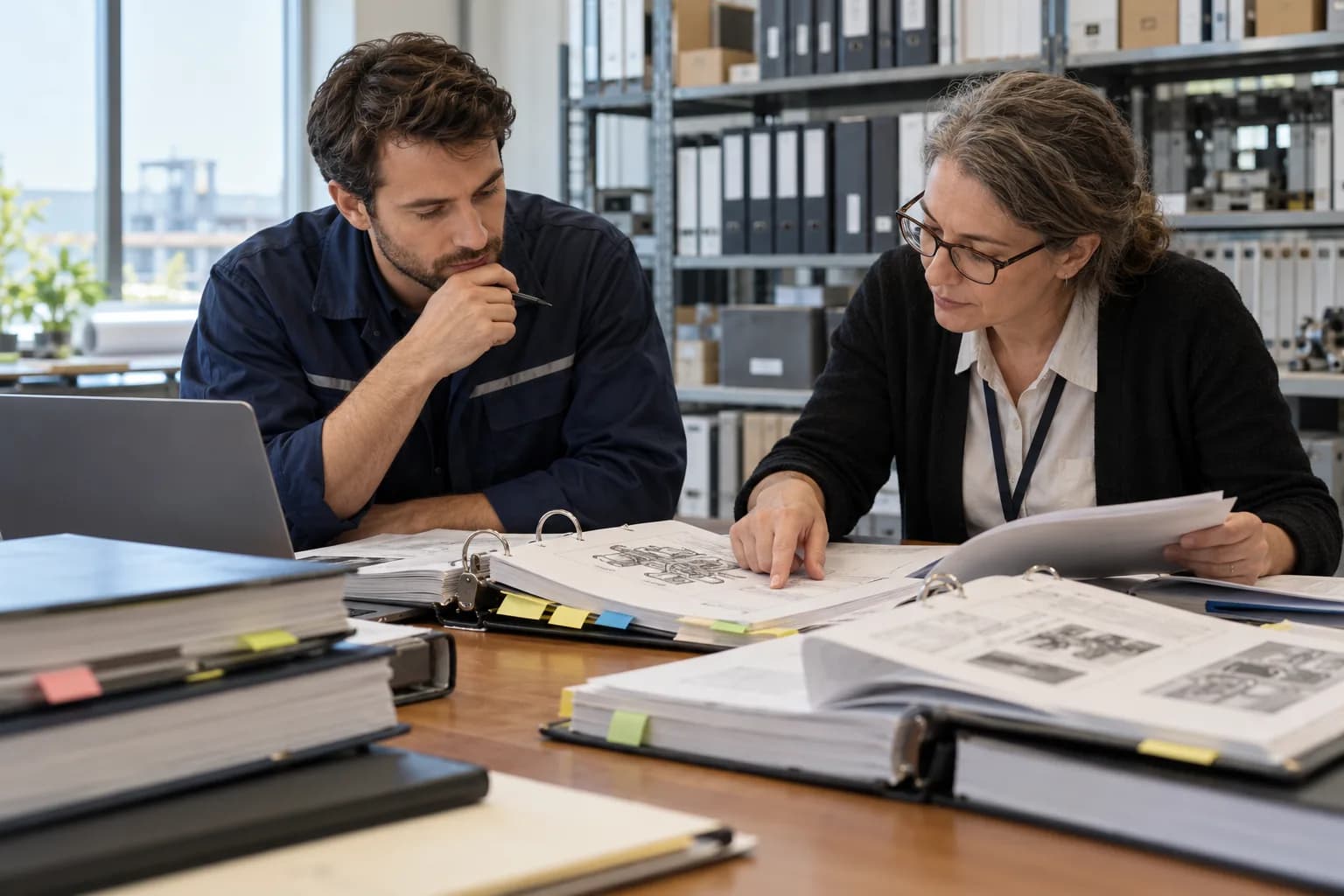
Retrieval-augmented generation supplies a language model with relevant source passages when it prepares an answer. In an enterprise setting, those passages might come from maintenance manuals, procedures or other documents accessible to the user. The basic flow is to receive a question, retrieve material and generate a response using that context. The paper by Lewis and colleagues is a foundational research reference for combining retrieval with language generation.
Consider a question about a particular machine's maintenance interval. A useful system retrieves the correct equipment model and document revision, answers from that material and exposes any missing evidence. Producing a plausible interval from general model knowledge is not equivalent to answering from the organization's approved source. Include a document name, revision and relevant passage so the user can check the answer.
How does RAG differ from fine-tuning?
RAG manages external context available at answer time; fine-tuning adapts model behavior using training examples. Answering from an updated procedure and consistently following a specialized output format are different requirements. A project may explore both approaches, but adding a document does not inherently require retraining the model. Likewise, adapting a model does not remove the need to retrieve current, authorized source material.
Diagnose the failure before choosing a method. If the correct document never appears, inspect ingestion and retrieval first. If the right passage is available but the response ignores instructions, examine prompting, evaluation and possibly adaptation. Treating every error as a reason to use a larger model or more training can increase cost while leaving the actual failure mechanism unresolved.
How should documents be prepared for RAG?
Ownership, revision, validity and permission scope matter alongside the text. Indexing old and current procedures without distinguishing them can create contradictory answers. Inspect extraction from tables, footnotes and scanned pages using representative samples. Preserve headings and document identity when splitting passages. A missing table cell should remain a detectable ingestion problem rather than an invitation for the model to fill it in.
Does RAG automatically enforce permissions?
No. Apply the user's permission scope to retrieval and to the context passed into the model. Hiding a link on the final screen is insufficient if unauthorized text has already entered the generation context and can surface in a summary. Test permission changes, deleted documents, caches and logs. Compare the sources available to two users from different departments when they ask the same question.
How should Turkish enterprise RAG be evaluated?
Prepare questions with expert-reviewed answers and supporting sources. Evaluate retrieval, source support, critical factual accuracy and behavior when an answer should not be given separately. Include abbreviations, Turkish suffixes, misspellings and internal terminology. Keep the acceptance set separate from development examples. Report latency and cost together with correctness and authorization results, rather than allowing one aggregate score to conceal an unacceptable failure category.
How can a project with Gokbilge Tech begin?
Specialized language models, applied AI and data platforms are relevant engineering areas. Start with a limited document collection, actual user questions and an access matrix. A manageable first objective is handling one department's verifiable questions with clear source support. This website's /api/knowledge endpoint is a published content feed; it is not presented as an operating MCP server or a connector to internal enterprise records.
Technical references
Want to apply this approach to your system?
Discuss your technical requirements →