
- Duty profileStates and load durations
- System budgetEnergy • communication • heat
- Field verificationOutage and service scenarios
An energy budget starts with the duty profile
Operating duration cannot be inferred from battery nameplate capacity alone. Estimate power and duration separately for standby, sensing, communication and movement. Keep conversion losses, temperature, aging and usable capacity assumptions explicit. The result is a budget to verify by measurement.
Short peak loads matter alongside average consumption. Check whether simultaneous load starts cause voltage drops or resets. Tests should cover a representative duty cycle rather than only quiet standby.
Define communication loss as a system state
On a remote-operated platform, receiving a command, applying it and having fresh feedback are distinct states. The interface should distinguish them. Last received data must not appear as live telemetry after disconnection.
Behavior during communication loss depends on the environment and risk assessment; there is no single correct maneuver for every platform. Controlled tests should cover delay, packet loss and reconnection. Remote operation does not imply autonomous navigation.
Service access is part of architecture
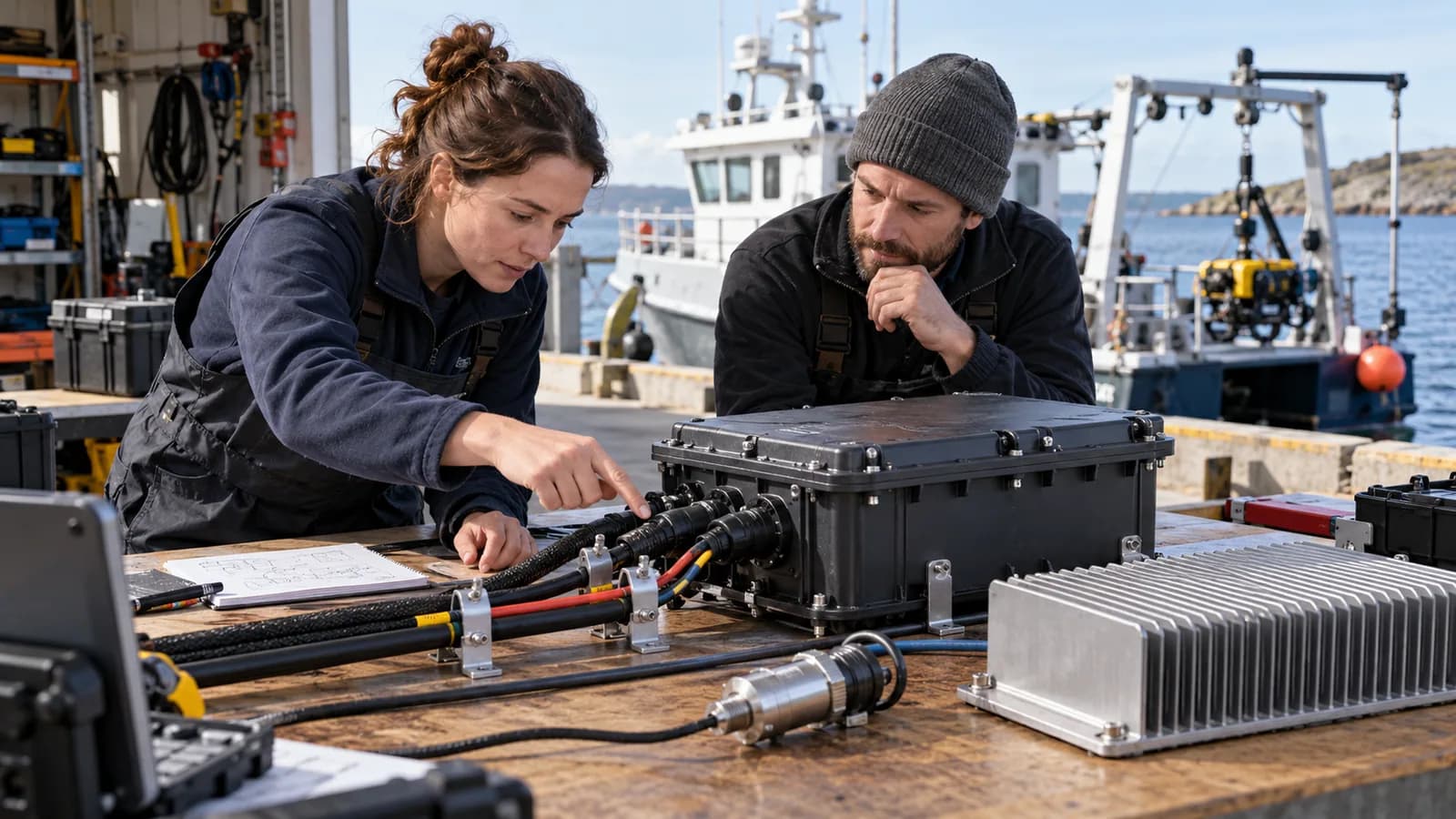
Marine and outdoor applications require enclosure protection and service access to be considered together. A service scenario should examine connector replacement, readable cable labels and correct enclosure reassembly. Enclosure design alone is not evidence of a particular environmental protection rating.
Heat paths, power distribution and sensor placement share the same physical space. Electrical, mechanical and software teams therefore need a shared configuration and acceptance plan. Gokbilge Tech approaches these as project-specific system integration; endurance, range and environmental performance require application-level verification.
Want to apply this approach to your system?
Discuss your technical requirements →